

Google Ads Changed One Rule. Your Target Is Now Your Price.
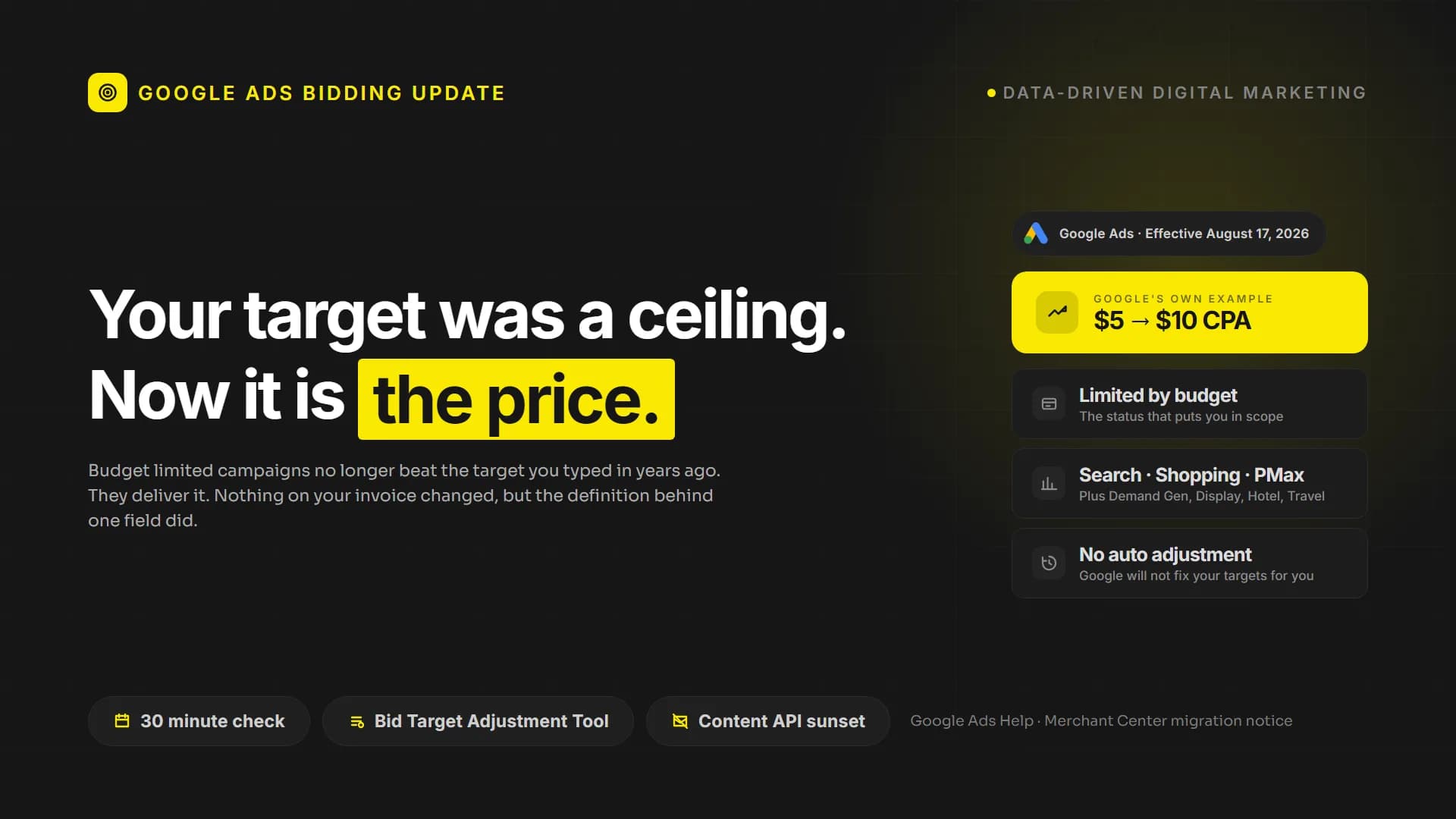
Google updated its bidding systems on August 17, 2026. Budget limited campaigns using Target CPA or Target ROAS now deliver closer to the target you set.
Imagine opening your September report. The budget is the same as August. The campaigns are the same, the keywords are the same, nobody touched anything. Yet the cost of winning a customer has moved up. Before you look for a culprit in your agency, your competitors or the season, check the calendar: on August 17, 2026, Google changed how its bidding systems work.
This is one of those changes that never reaches the news because it sounds like housekeeping. It is not. It quietly turns a number you typed into your account long ago into the price you pay today.
What actually changed
Two terms first, in plain language.
Limited by budget means your daily budget is not enough for the demand your campaign could capture. Google shows this as a status on the campaign row. Most small and midsize accounts live here permanently.
Target based bidding means the strategy where you tell Google the result you want: Target CPA (the cost you are willing to pay for a conversion) or Target ROAS (the return you want on ad spend).
In Google's own words, on August 17, 2026, it "updated its bidding systems to deliver more consistent and predictable performance based on the targets you set." Campaigns that are limited by budget and use a target based strategy "now perform more consistently toward your bid target, including when you make budget adjustments."
Google gives the example itself: if your Target CPA is 10 dollars but your recent actual CPA is 5 dollars, the campaign now delivers more closely to a 10 dollar actual CPA.
Read that twice, because it is the whole story. A campaign that was quietly beating its target is no longer asked to keep beating it. It is asked to hit it.
Which campaigns are in scope
Google lists the types this applies to: Search, Shopping, Performance Max, Demand Gen, Display, Hotel and Travel campaigns. App campaigns, Video reach campaigns and Video view campaigns continue with the previous bidding behavior. Google's explanation is written around the budget limited case, so if your campaigns comfortably spend their budget, do not assume anything about them from this page.
What it means for a company in Türkiye
Two things.
First, the affected group is larger here than it looks. Most SME advertising accounts in Türkiye run with budgets that cannot absorb all available demand, which is exactly the state Google describes. If that is your account, this change is about you.
Second, and more important: the number in the target field is a target, not a ceiling. A company that entered an optimistic Target CPA in 2024 and never revisited it may have been enjoying results better than that figure for months. After August 17, the same setting reads as an instruction to spend up to it. Nothing on the invoice changed. The definition behind one field did.
Google is explicit that it will not clean this up for you: "Google will not automatically adjust your bidding targets or budgets." It advises checking that your settings match your business goals, especially for campaigns performing better than their targets.
The check to run this week
This is a thirty minute job for one person with account access.
1. In the campaign table, look at the status column and list every campaign showing Limited by budget. That is your affected group.
2. For each of them, put the last 30 days of actual CPA and actual ROAS next to the Target CPA and Target ROAS in the settings. A visible gap means the campaign has been performing better than its target, which is precisely the case Google's change addresses.
3. Open the Bid Target Adjustment Tool. Google says it is live and has been reachable since July 6, 2026, from account notifications or the Campaigns page. If it does not appear in your account, do the comparison manually; the decision is the same.
4. Decide, do not react. Google offers an Apply option that updates the target to recent performance, or you can enter a target that matches your business goals. Changing a target changes how fast the account spends, so agree on it with whoever owns the budget before you touch it, and write down every change with its date.
5. Add a note to your monthly and quarterly reports marking August 17, 2026, as a break point. Anyone comparing September with August without that note will draw the wrong conclusion about the work, not about the platform.
One caution against the opposite mistake: this is not a promise that your costs will rise. Google's framing is about predictability, saying you can increase budget without efficiency fluctuating unexpectedly. If your campaigns already run close to their targets, you may see very little. The accounts that will feel it are the ones whose targets were left far above what they were actually achieving.
If you use Merchant Center, one more thing
Unrelated to bidding, but it lands in the same weeks and it is worth one question to whoever maintains your store. Content API for Shopping was sunset on August 18, 2026, and starting September 1, 2026, requests to it return progressive errors. If your product data is synced through a third party technology partner, Google says you do not need to do anything and your provider handles the migration; it gives the Google and YouTube app on Shopify as its own example. If your feed is sent by a custom integration, ask this week whether it uses Content API or the newer Merchant API. Google has published no deadline for its extended access request, so this is not a question to leave for later.
The pattern behind it
The era of set and forget fields in an ads account is closing. A platform can redefine what a setting means without touching your budget, your campaigns or your creative, and the first place you notice it is a report that looks worse for no reason you can name.
So before you compare September with August, run the check above. If you would like us to produce the budget limited comparison for your account, write to us and we will take a look.
Your site may look great. Does it actually work?
PumpAudit is the AI assisted auditor built by Pumpmedya. It analyzes your site across five areas, every finding is checked by a specialist, and the report is with you within 3 working days. Credited against your first project.
See PumpAuditKeep reading
 Digital Marketing Strategy
How Does Google Ads Work? A Practical Guide for Small Businesses
 Digital Marketing Strategy
How to Choose SEO Services in the AI Era: What to Ask Before You Hire
 Data-Driven Digital Marketing