
What Is Data-Driven Marketing? A Complete Guide for Companies That Want Growth They Can Measure
Data-driven marketing means every decision rests on measured customer behavior instead of guesswork. What the loop looks like in practice, how to build it in three stages, and the mistakes that quietly break it.
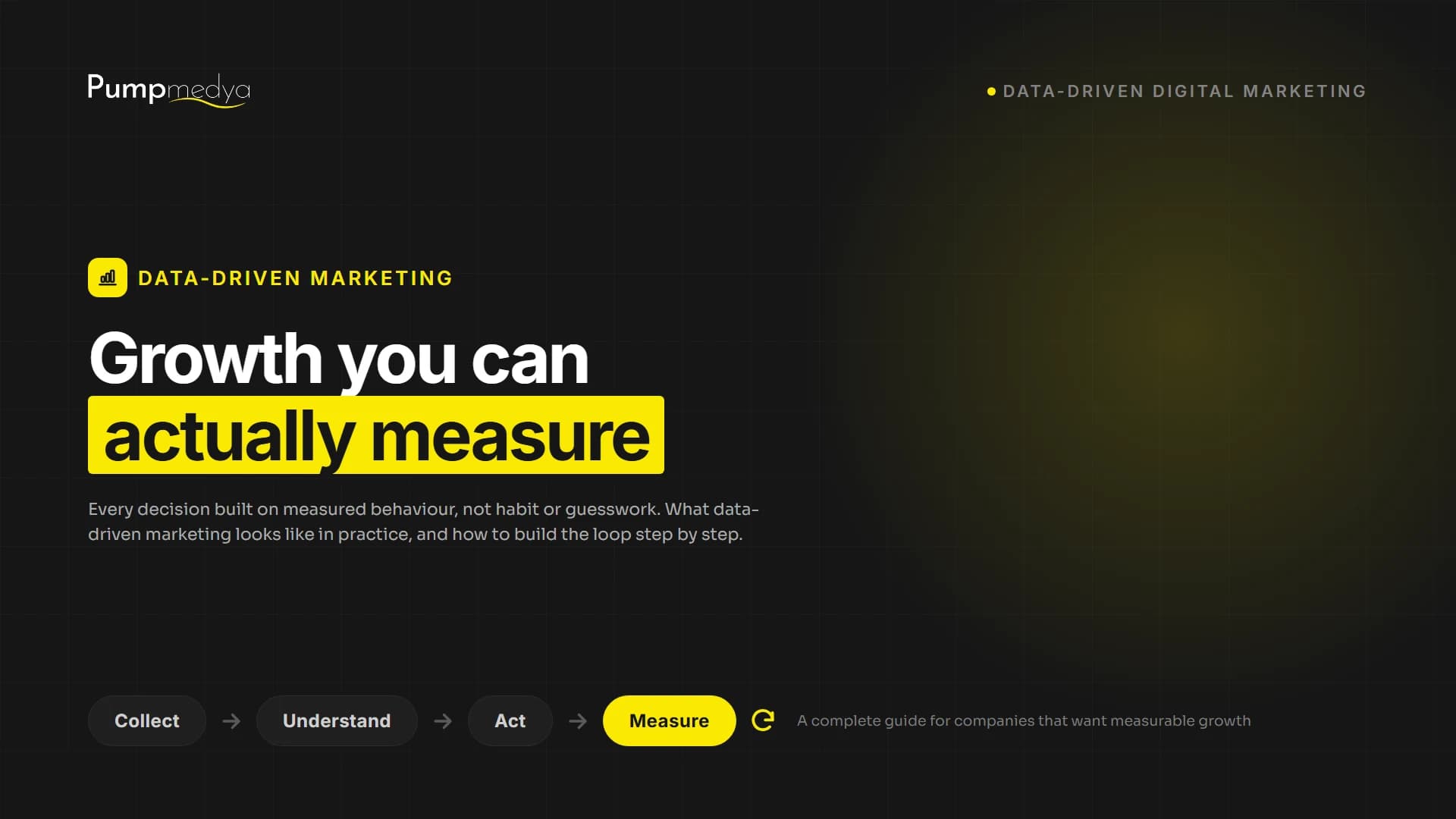
Data-driven marketing is the practice of making every marketing decision (what to say, where to say it, how much to spend and what to do next) based on evidence from measured customer behavior rather than on habit, opinion or guesswork. In practice it means one connected loop: collect what happens, understand why it happened, act on it, and measure again.
That definition fits in two sentences. Living it is what separates companies that grow on purpose from companies that grow by accident. This guide covers what data-driven marketing looks like in practice, why it matters more in 2026 than ever, how to build the loop step by step, and the mistakes that quietly break it.
Why "data-driven" stopped being optional
Two shifts made intuition-based marketing unaffordable. First, buying journeys fragmented: a single customer might discover you through an AI assistant's answer, check your site from a social link, and convert weeks later through a search. If you measure only the last step, you will credit the wrong channel and fund the wrong work. Second, answers started replacing clicks: a growing share of searches now ends without a visit to any website, so the visits you do earn carry more weight and deserve more understanding.
The companies that thrive in this environment are not the ones with the most data. They are the ones whose data is connected enough to answer plain questions quickly: Which channel brings the customers that stay? What did last month's spend actually return? What should we stop doing?
The four parts of the loop
Every working data-driven operation, whatever tools it runs on, has the same four parts.
1. Collection that respects reality
Track the touchpoints you actually control: your website, your forms, your campaigns, your emails. Capture where visitors come from at the moment they arrive, because referrer information is fragile and disappears if you try to reconstruct it later. Be honest about the gaps; some channels (many AI assistants, some private browsers) send no source information at all, and a good setup records "unknown" rather than inventing an answer.
2. Attribution that tells the truth
Attribution is the discipline of connecting an outcome (a lead, a sale) to the journey that produced it. The practical standard is two timestamps per contact: the first touch (how they originally found you) and the latest touch (what brought them back when they converted). Neither alone is the full story; together they show which channels open relationships and which ones close them.
3. Activation, or letting the data change your behavior
Data that never changes a decision is decoration. Activation means concrete links between insight and action: the channel report decides next quarter's budget, the content report decides what you write next, the lead-source report decides which partnership you renew. If you cannot name the last decision your analytics changed, you have reporting, not data-driven marketing.
4. Measurement as a habit, not an event
Monthly report rituals belong to the previous era. When your numbers live on a dashboard you can open any morning, two things change: mistakes get caught in days instead of quarters, and experiments become cheap, because you see their effect while they run.
How to start: a realistic maturity path
Most companies fail at this by attempting everything at once. The workable path has three stages.
- Stage one: see clearly. One analytics setup, source tracking on every lead, and a single dashboard that shows visits, leads and their origins in one place. No predictions, no automation; just an honest picture. Most businesses have never had even this.
- Stage two: connect the money. Tie leads to outcomes: which became customers, what they were worth. Now channel reports talk in revenue, and budget conversations become short.
- Stage three: close the loop. Let the system act on what it knows: campaigns that pause when they underperform, content plans built from what already earns visits, alerts when something breaks. This is where a marketing stack starts behaving like a growth system.
Notice what the stages have in common: each one is useful on its own. You are never building infrastructure "for later".
The mistakes that quietly break it
- Vanity metrics as north stars. Impressions and follower counts move without moving revenue. Anchor on metrics a CFO would accept: qualified leads, cost per acquired customer, revenue per channel.
- Tool sprawl. Five disconnected tools produce five versions of the truth, and reconciling them becomes a job in itself. Fewer, connected pieces beat many brilliant ones.
- Ignoring the invisible. Some of your best channels underreport themselves; treat every measurement as a floor, and pair the numbers with plain questions to new customers: how did you find us?
- Data without a decider. Dashboards do not make decisions; someone must own the weekly look at the numbers and the authority to act. Name that person.
Where this is all heading
The rise of AI assistants makes the data loop more valuable, not less. As more discovery happens inside generated answers, the companies that measure which content earns citations in AI search, which channels still deliver visitors and what those visitors do next will be the ones that adapt first. Measurement is becoming the marketing skill, and the earlier it becomes a habit, the more compounding works in your favor.
Frequently asked questions
Is data-driven marketing only for large companies?
No; it matters most for small ones, because they can least afford wasted spend. A modest but connected setup answers the questions that matter at any size.
How is it different from just "doing analytics"?
Analytics describes what happened. Data-driven marketing requires the loop to close: the numbers must change what you do next, and then be measured again.
How long until it pays off?
Stage one pays off immediately, in stopped waste; you usually find at least one channel or expense that produces nothing. Revenue-level insight arrives when enough closed deals have flowed through, typically within a quarter or two.
Start with one question
If this guide leaves you with a single action, make it this: ask "where did our last ten customers actually come from?", and refuse a guessed answer. Everything in data-driven marketing grows from being unable to answer that question and deciding you should be.
If you would rather run on a system where the loop is already built and connected, that is exactly what we do. Talk to us.
Your site may look great. Does it actually work?
PumpAudit is the AI assisted auditor built by Pumpmedya. It analyzes your site across five areas, every finding is checked by a specialist, and the report is with you within 3 working days. Credited against your first project.
See PumpAudit