

Do 95% of Enterprise AI Projects Really Fail? A Closer Read of the MIT Report
Everyone shares MIT's 95% statistic; almost nobody reads the report. We read all 26 pages: what the 95% actually measures, the shadow AI economy, and what really failed.
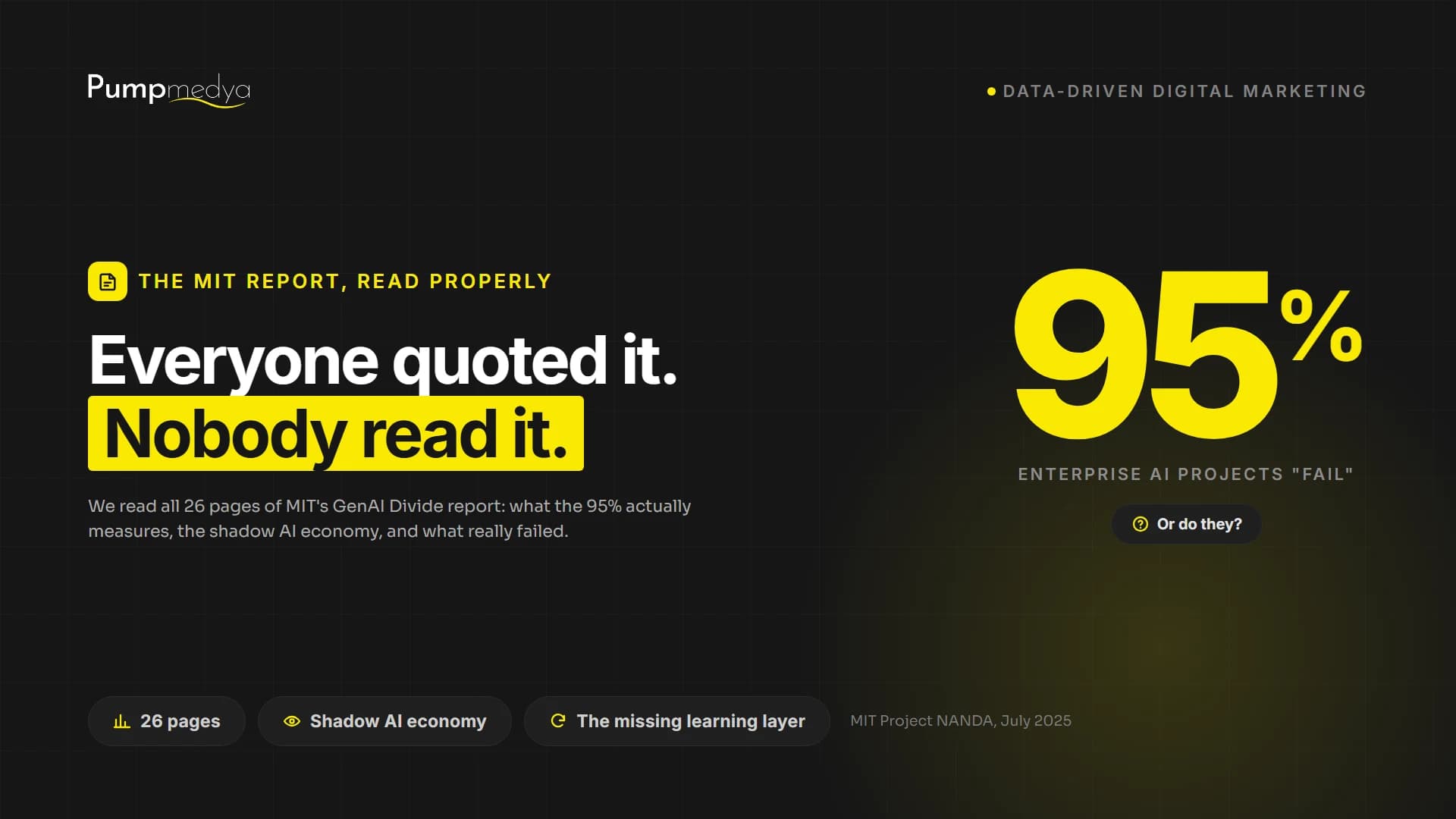
"95% of enterprise AI projects fail."
You have probably seen this sentence fifty times this year. So have we. Then we downloaded the report itself and read all 26 pages. It is worth reading, but not for the reason it went viral.
What does the 95% actually measure?
The statistic comes from "The GenAI Divide: State of AI in Business 2025", a July 2025 report by MIT's Project NANDA (Challapally, Pease, Raskar and Chari). The research draws on interviews with 52 organizations, a survey of 153 senior leaders and a review of more than 300 publicly disclosed AI initiatives.
Look at the report's own definition. To count as "successful", a tool has to produce what users or executives describe as a "marked and sustained productivity or P&L impact", assessed six months after the pilot. In other words, what is being measured is not the balance sheet but what interviewees say. The report's own research note says as much: the figures are based on individual interviews rather than official company reporting, and should be treated as directional.
Furthermore, in the limitations section the authors admit that a six month observation window may be too short for complex enterprise deployments, which would understate success rates.
So the finding is not "AI does not work". The finding is: most pilots, at the six month mark, had not yet paid off in the eyes of the people interviewed. Those are not the same sentence.
Three findings nobody quotes
1. The shadow AI economy. Only 40% of surveyed companies bought an official LLM subscription. Yet in over 90% of the same companies, employees already use personal AI tools to do their jobs. The report calls this the "shadow AI economy".
2. The budget figure is not a measurement. The share of AI budgets going to sales and marketing appears as 50% in one section of the report and 70% in another. The source of the number is a question asking executives to split a hypothetical $100 across functions. Read it as a mood, not a measurement.
3. External partnerships versus internal builds. Externally partnered projects reached deployment around 67% of the time, internally built ones around 33%. We sell services, so it is natural to read that number from us with suspicion. The report carries the same suspicion itself: it states plainly that the gap may reflect organizational capability rather than the build-or-buy decision, and that correlation does not prove causation.
In the same company, AI both "fails" and gets used every day
Put the picture together. The company says its official project "did not deliver results". Inside that same company, people use AI every day, often on personal accounts they pay for themselves, and finish their work faster.
Nobody measures it. Nobody connects that gain back to the business results.
The report's own diagnosis points the same way: the core barrier to scale is not infrastructure, regulation or talent. It is learning. The tools do not retain feedback, adapt to context or improve over time. In the same dataset, roughly 83% of general-purpose tool pilots reached use, 70% of users prefer AI for quick tasks, while for complex, long-term work people prefer humans nine to one.
So what failed is not AI. What failed is the infrastructure that turns individual productivity into organizational results: the measurement, integration and learning layer. In most companies, that layer was never built.
The report describes exactly what we built
The report has a finding that touches our industry directly: the real savings mostly show up in the back office, and one line item is a roughly 30% reduction in external agency and content spend.
That finding does not worry us; it is exactly why we built PumpGrowthOS. It was already clear that the classic agency model, doing repeatable work by hand and invoicing for it, would lose to AI. Look at where the report lists what separates the "successful 5%": systems embedded in processes, measurable business outcomes, deployments that learn over time. That is our model too: instead of selling agency services, build the measurement infrastructure, the data-driven decision loop and the automation embedded in processes, then operate growth on top of that system.
Put differently, when the report says "cut your agency spend", it also describes what to move to, and what it describes is not an agency but a growth system. We laid out what that approach looks like in practice, step by step, in our data-driven marketing guide.
A note on transparency
The report comes from MIT's Project NANDA. NANDA is an initiative building protocols that let AI agents work together, and the report's conclusion happens to be that "the answer is agent-based systems". That does not make the report wrong. It does mean the data and the conclusion deserve to be read separately. That is what we have done in this article.
If AI "is not working" at your company
Check these four questions first:
- What are your employees already solving with personal accounts? Shadow usage is the most honest indicator of what actually works.
- Which metric do you use to measure AI's impact? Without measurement, the "failed" verdict rests on impressions, not data.
- Did you start the pilot with a grand vision or with one narrow process? The working examples in the report share two traits: narrow scope and fast, visible value.
- Does the tool you bought learn from your process, or does it start from zero every time?
The question is not "does AI work?". The question is: is it actually not working, or is it working somewhere you are not looking?
Source: Challapally, Pease, Raskar, Chari. "The GenAI Divide: State of AI in Business 2025", MIT Project NANDA, July 2025. Report PDF
Your site may look great. Does it actually work?
PumpAudit is the AI assisted auditor built by Pumpmedya. It analyzes your site across five areas, every finding is checked by a specialist, and the report is with you within 3 working days. Credited against your first project.
See PumpAuditKeep reading
 AI and Business Technology
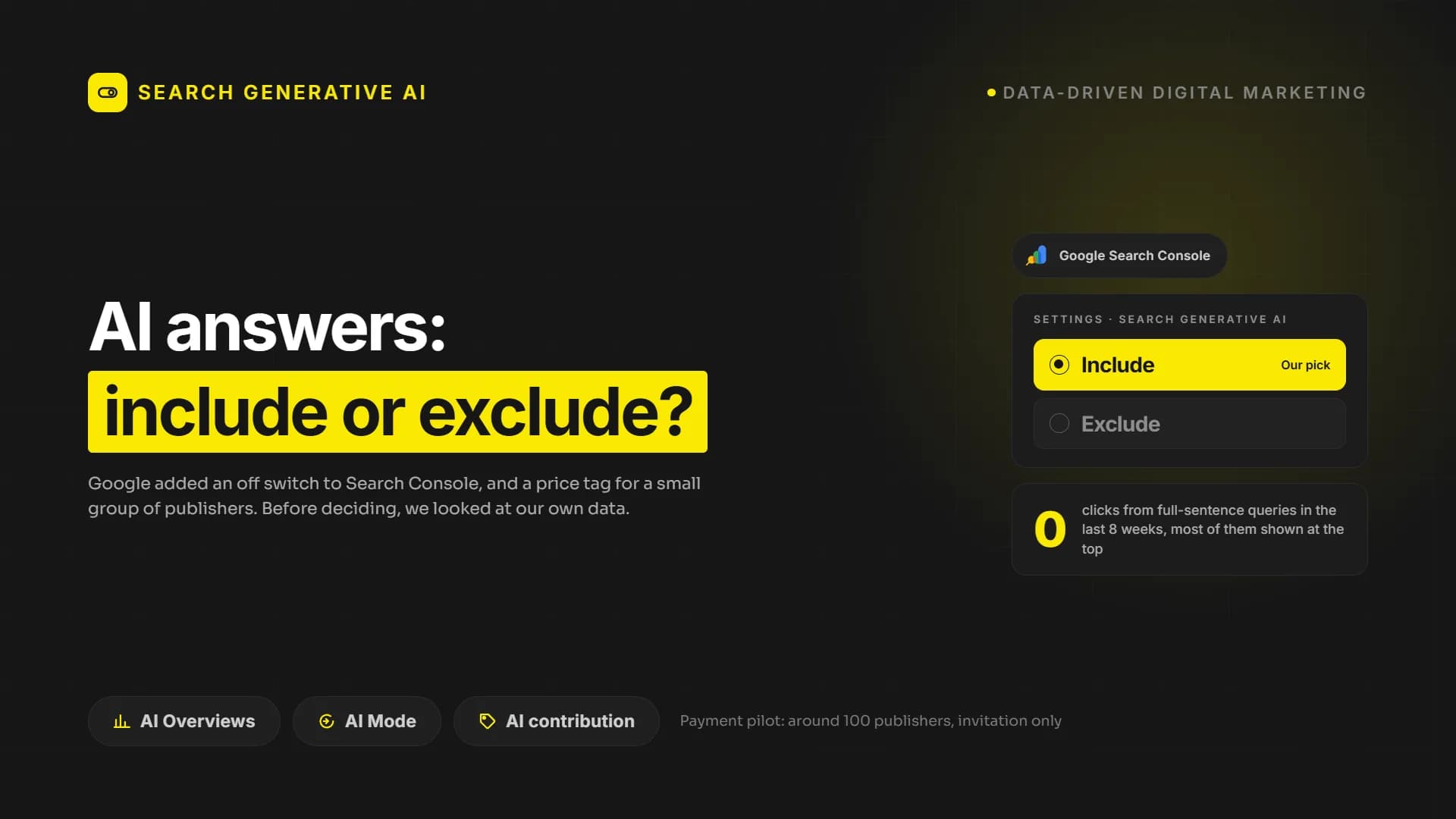
Google Now Has an Off Switch for AI Answers, and a Price Tag. Our Data Says Which One Matters.
 AI and Business Technology
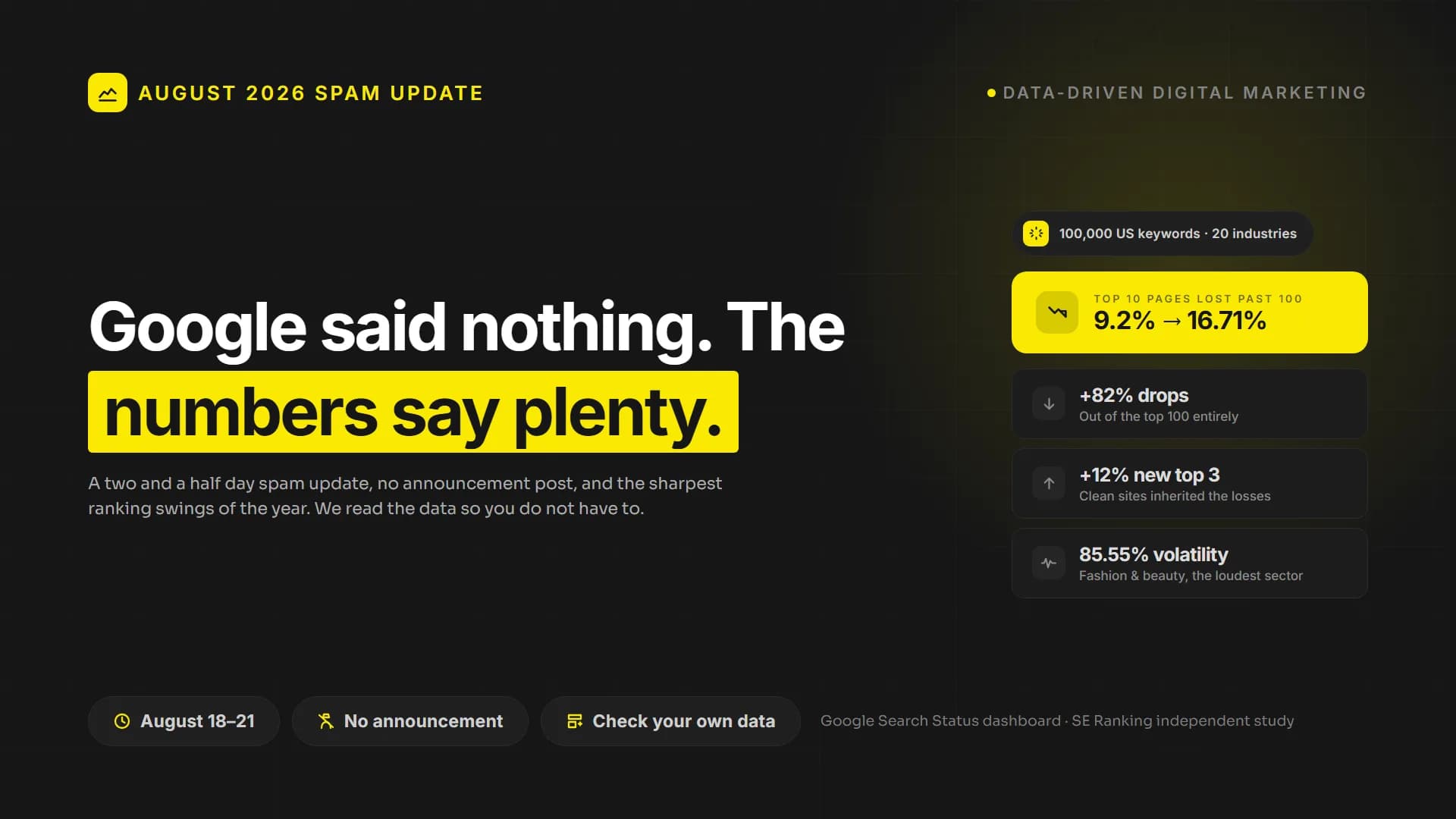
Google Ran a Spam Update and Said Nothing. The Numbers Say Plenty.
 AI and Business Technology