

How to Get Your Brand Cited by AI Search: A Practical Guide to Generative Engine Optimization (GEO)
A growing share of your customers now ask AI assistants instead of searching. GEO is how your brand becomes part of the answer: what it is, how it differs from SEO, and a checklist you can apply this quarter.
For twenty years, being found online meant one thing: ranking on a search results page. That era is not over, but it is no longer alone. A growing share of your potential customers now ask an AI assistant instead of typing keywords into a search box, and the answer they receive mentions a handful of brands at most. If yours is not one of them, you are invisible in a channel that did not exist three years ago.
This is the problem Generative Engine Optimization (GEO) solves. Here is what it is, how it differs from the SEO you already know, and what you can do about it this quarter.
What is GEO?
Generative Engine Optimization is the practice of making your content easy for AI systems to find, understand, trust and cite. Where classic SEO competes for a position in a list of links, GEO competes for a place inside the answer itself. The AI assistant reads many sources, synthesizes one response, and credits only the sources it found most useful. GEO is the discipline of becoming one of those sources.
The shift behind it is measurable. Industry analysts expect traditional search volume to decline sharply as answer engines absorb everyday questions, and consumer research shows AI-assisted search has already become a primary discovery channel for a large share of buyers. The exact numbers change monthly; the direction does not.
How GEO differs from SEO
The good news: GEO is not a replacement for SEO, it is an extension of it. Almost everything that makes a page rank well also makes it citable. But the emphasis shifts in five ways:
- Answers beat keywords. AI systems extract passages, not pages. Content structured as clear questions and direct answers gets lifted into responses far more often than clever copy.
- Being quotable matters. A crisp definition, a numbered process, a concrete example: these are the units AI answers are built from. If your page contains the best two-sentence explanation of a topic on the internet, you will be quoted.
- Authority is cross-checked. Answer engines weigh whether other credible sources agree with you. Consistent facts across your site, your profiles and third-party mentions matter more than ever.
- Structure is read literally. Proper headings, schema markup, clean HTML and fast pages are not hygiene anymore; they are how machines parse your expertise.
- Freshness counts twice. AI systems increasingly prefer recently updated sources, and they re-crawl faster than you might expect.
A practical GEO checklist
Here is what we apply on our own platform and recommend to every brand we work with:
- Answer one real question per page, and answer it in the first hundred words.
- Add an FAQ section to key pages, marked up with FAQ schema.
- Keep one consistent definition of what your company does, everywhere it appears.
- Publish original observations from your own work; AI systems favor sources that add information, not sources that repeat it.
- Use descriptive headings that could stand alone as sentences.
- Keep your organization schema, address data and profiles aligned.
- Update cornerstone content on a schedule, not when you remember.
- Make pages fast and render content without requiring interaction.
None of this is exotic. It is disciplined content engineering, which is precisely why most brands will not do it, and why the ones that do will be quoted.
The part almost everyone skips: measuring AI traffic
A channel you cannot see is a channel you cannot manage. Most analytics setups still file visitors from AI assistants under "referral" or lose them entirely. We treat AI as a first-class acquisition channel: our own attribution system classifies visitors arriving from AI assistants separately, so we can see which content earns citations and what those visitors do next. One honest caveat belongs here: some AI tools send no referrer information at all, so every measurement of this channel is a floor, not a ceiling.
If you run a growth system rather than a stack of disconnected tools, adding this lens is a small step. If you cannot answer "how many of my leads came from AI answers last month", that is a sign your measurement needs to catch up to your market.
Where this is heading
Answer engines are becoming multimodal, faster to update and more deeply embedded in the places people already work. The brands that win citations early will compound that advantage the same way early SEO adopters did in the 2000s. The window where GEO is a differentiator rather than table stakes is open now; it will not stay open long.
Start this quarter
Pick your ten most valuable pages. Rewrite each one to answer its core question directly, add the schema, align the facts, and set a refresh schedule. Then start measuring the channel. That is a complete first GEO program, and it fits in a quarter.
If you would rather have a system where this is built in, that is exactly what we build. Talk to us.
Your site may look great. Does it actually work?
PumpAudit is the AI assisted auditor built by Pumpmedya. It analyses your site across five areas, every finding is checked by a specialist, and the report is with you within 3 working days. Credited against your first project.
See PumpAuditKeep reading
 Data-led Digital Marketing
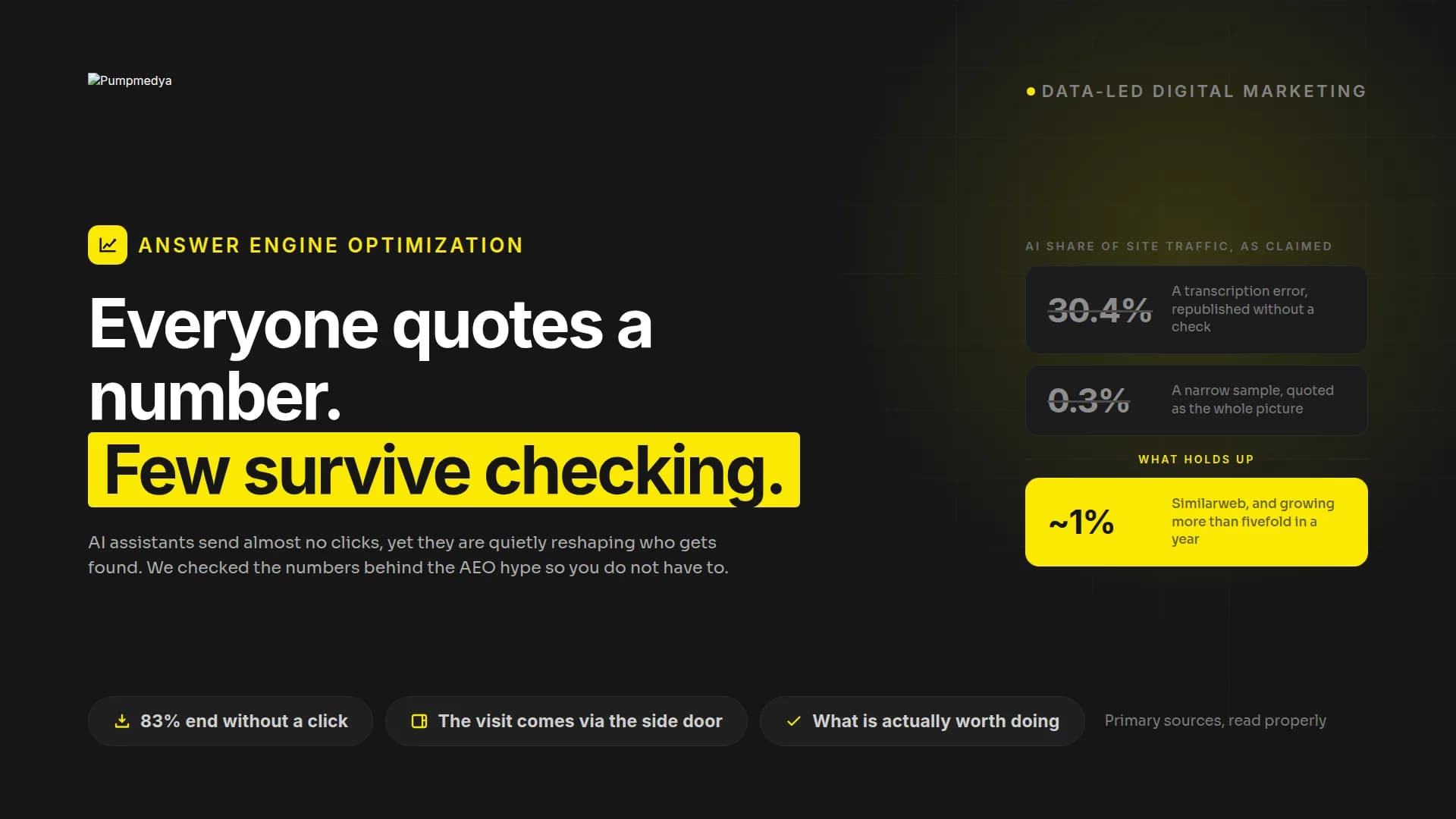
Answer Engine Optimization: What the Numbers Actually Say
 AI and Business Technology
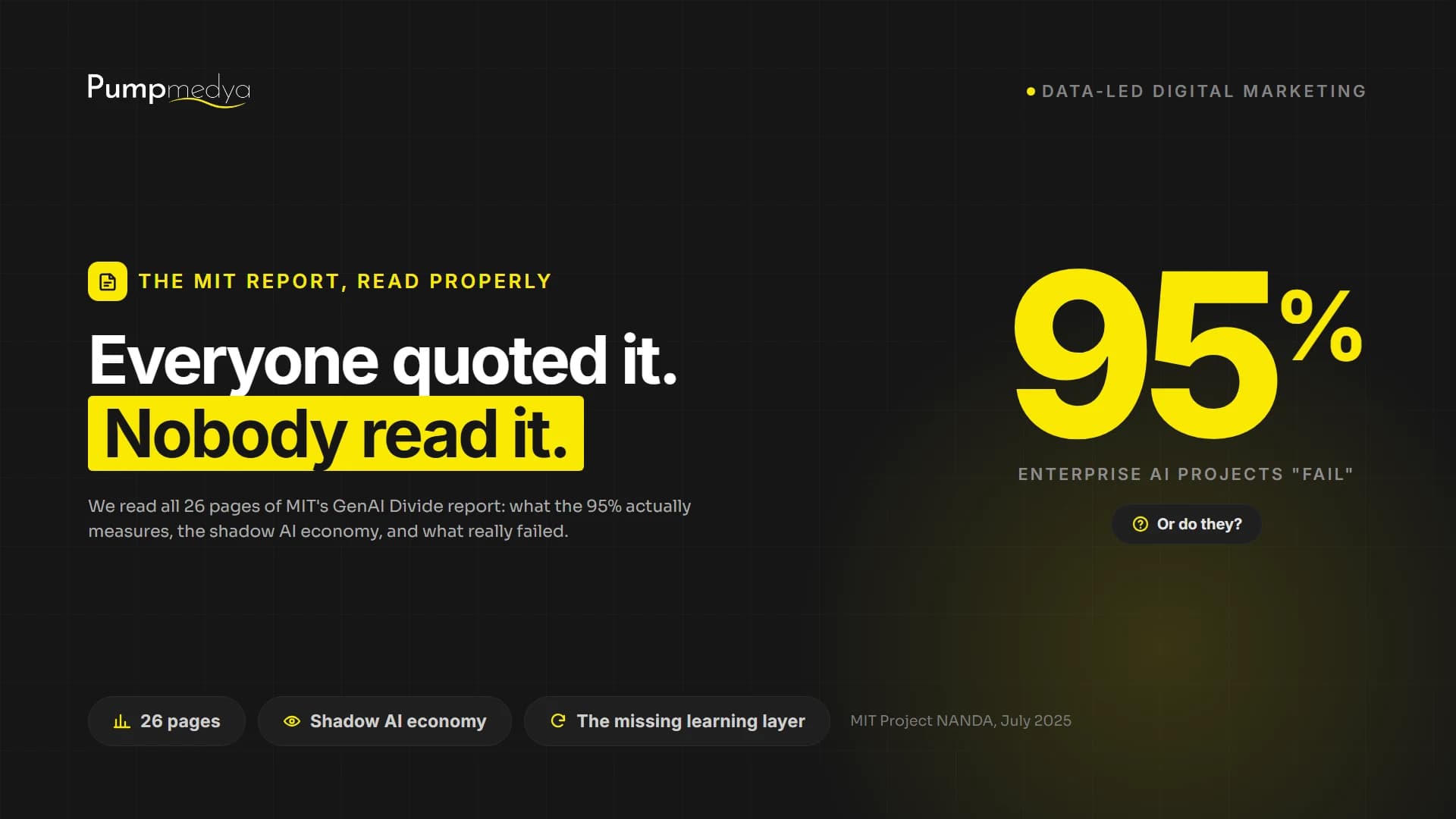
Do 95% of Enterprise AI Projects Really Fail? A Closer Read of the MIT Report
 Data-led Digital Marketing