
What Does a Google Ads Agency Do? Services, Fees and Questions to Ask
A Google Ads agency is the team that sets up, runs and measures your ad account. We cover what a good Google Ads management service includes, how fees are set, why the account should stay in your name and what to ask before you sign.
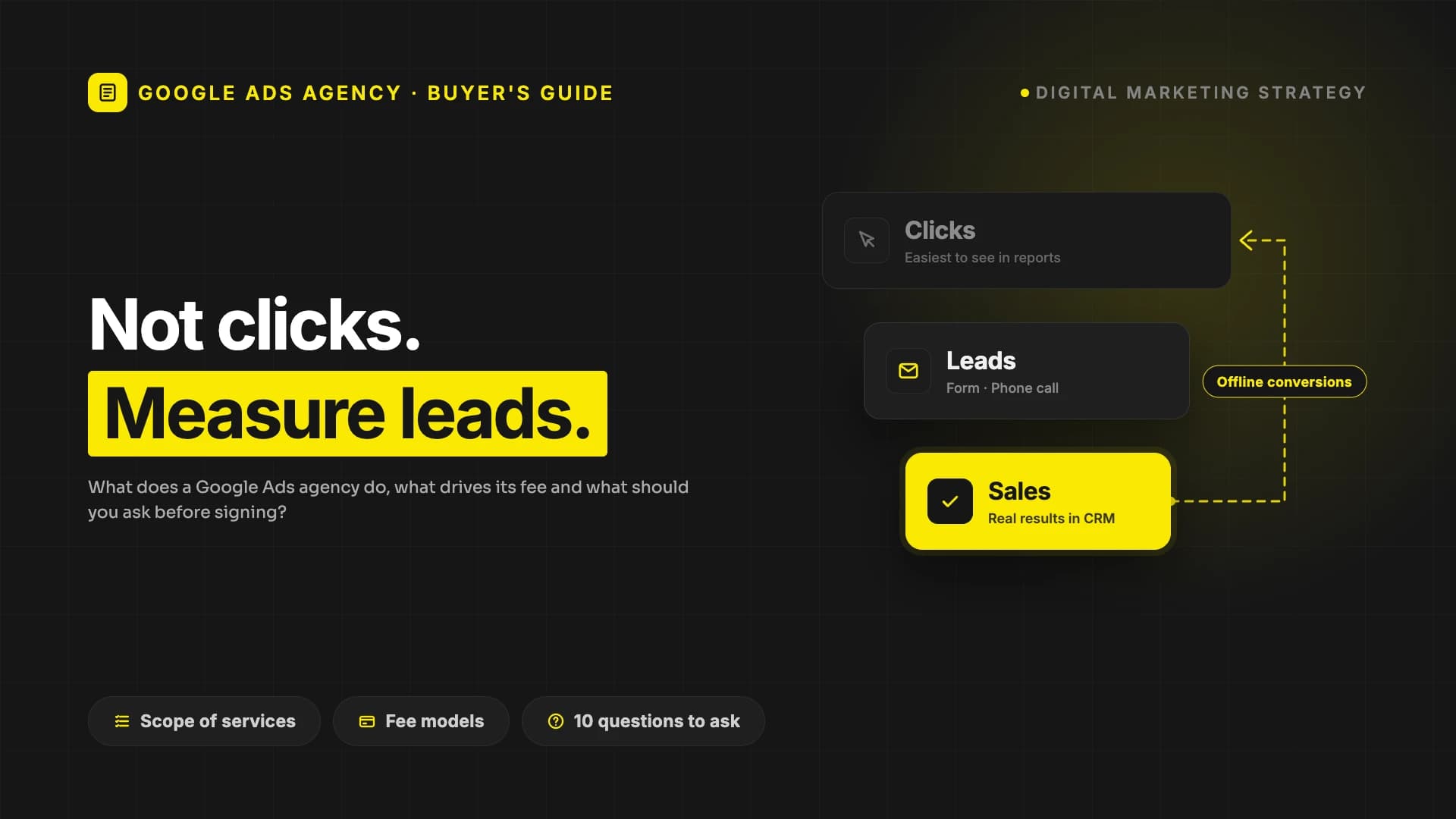
Short answer: A Google Ads agency is the team that sets up, runs and measures a Google ad account on behalf of a business: conversion tracking, campaign structure, ad copy, bidding strategy and reporting. To pick the right agency, look past promises of clicks and focus on how it measures qualified leads and sales, how it explains its fee and who keeps the account.
Once you decide to hire a Google Ads management service, the first thing you notice is how similar all the proposals look. Most promise more clicks, lower costs and fast results. The difference usually shows up a few months later, after a big chunk of the budget has been spent: clicks in the reports are up, but the leads coming in are not what you expected.
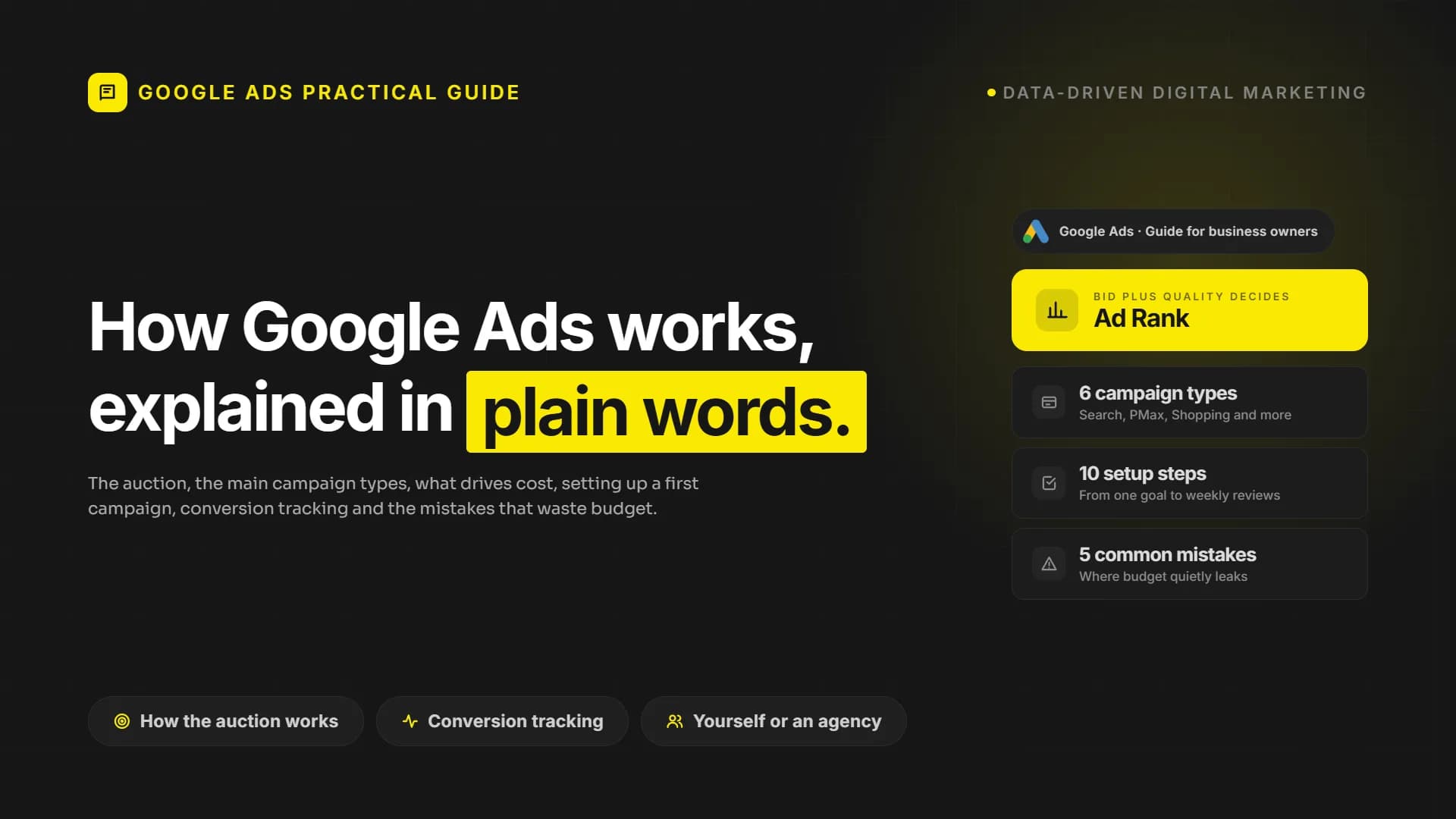
In this article, we walk through what a good Google Ads agency actually does, how fees are set, what the Google Partner badge means, why the account should stay with you and what to ask before you sign a contract. If you want to learn how Google Ads works from the ground up first, start with our Google Ads guide.
What does a Google Ads agency do?
Google Ads management is not about launching a campaign and walking away. It means reviewing and improving the account every week. Good Google Ads management services usually include the following:
- Measurement setup: Recording real goals such as form submissions, phone calls or purchases accurately as conversions. Without this, budget and bidding decisions are based on guesswork.
- Account and campaign structure: Choosing campaign types based on your services, service areas and budget, and organizing keywords into groups that make sense.
- Ad copy and assets: Headlines that match the search, copy that clearly says what your business offers, sitelinks and other ad assets.
- Landing page recommendations: Pages that echo the promise of the ad and make the next step obvious. If the page is weak, even the best campaign wastes budget.
- Weekly optimization: Reviewing the search terms report, adding unwanted searches as negative keywords, and adjusting budgets and bids based on results.
- Reporting: A regular report that explains what was done, what changed and what it means for leads or sales.
- Connection to sales data: Sending information from your CRM about which leads became customers back to the ad account as offline conversions. That way, Google's automated bidding learns from real sales, not from the number of form fills.
If a proposal only mentions campaign setup and a monthly report, the part of the work that makes the biggest difference is missing: ongoing optimization and measurement.
How is Google Ads agency pricing set?
First, separate two line items: the ad spend paid to Google and the management fee paid to the agency. Depending on the campaign type, ad spend is mostly paid to Google per click or per conversion. The management fee is what the team running the account charges. Agencies usually set this fee in one of four ways:
- Percentage of ad spend: The fee is a set percentage of monthly ad spend. It is simple, but the fee goes up as spend goes up, so keep that in mind when you get advice to increase the budget.
- Flat monthly fee: A flat fee for work with a scope defined up front. Budgeting gets easier; having the scope in writing is what matters.
- Hybrid model: A flat base fee, plus a percentage of the spend above an agreed amount.
- Performance-based fee: Payment per lead or per sale. It sounds appealing, but unless the definition of a "lead" is spelled out in writing, the focus can shift to volume instead of quality.
The main factors that drive the fee are the type and number of campaigns, how many countries and languages are targeted, who creates the ad copy and visuals, whether landing page work is in scope and whether measurement includes CRM data or offline sales.
Google also has a rule for agencies on this. Under Google's third-party transparency requirements, an agency that charges a management fee separate from the cost of Google Ads must inform new customers in writing before their first purchase and disclose the fee on customer invoices. If a proposal lumps ad spend and the management fee into a single number, your first question should be how much each one is.
What does the Google Partner badge mean?
The Google Partner badge shows that an agency meets requirements set by Google. According to Google's Partners program page, these fall into three categories: a minimum optimization score of 70% on the manager account registered with Google Partners, at least $10,000 USD in ad spend across managed accounts over 90 days, and at least half of the account strategists certified in Google Ads. Premier Partner status goes to companies that meet these requirements and are in the top 3% of participating companies in their country, and it is determined annually.
The badge shows that the agency manages a certain volume of ad spend and that its team is certified. It does not guarantee results in your industry with your budget. Optimization score, one of the badge requirements, also needs to be read the right way: Google defines it as an estimate of how well your Google Ads account is set to perform, and notes that you can dismiss recommendations that are not relevant to your campaign. Applying every recommendation just to push the score up may not be right for your account. A good agency evaluates recommendations one by one against your goals and turns down the ones that do not fit, with a reason.
Who should own the account?
This is one of the first things to nail down before you sign. The Google Ads account, the conversion tracking setup and the Google Analytics property should be created under your company's name, and you should keep Admin access for at least one of your own users.
Google Ads has five access levels: Admin, Standard, Read-only, Billing and Email-only. Only Admin access lets you decide who can access the account and unlink the agency's manager account. Agencies typically manage client accounts by linking them to their own manager account; according to Google's manager account page, users with administrative access to the client account can end this link at any time.
If the account was created under the agency's name, you may not be able to take years of campaign history and conversion data with you when the relationship ends. No matter whose name the account is under, Google requires agencies to give customers their Google Ads customer ID when requested. Ask for this ID in the first meeting.
Red flags when choosing a Google Ads agency
- Guaranteed rankings or clicks: An auction decides on every search whether an ad is shown, so no one can guarantee a specific position or number of clicks. In its third-party policies, Google also lists guaranteeing top placement, offering "unlimited clicks" and making false statements about how costs are calculated among its examples of misleading claims.
- No access to the account: If you cannot see your account, every number in the reports is one the agency chose to show you.
- Click reports instead of conversions: Clicks, impressions and click-through rate are interim metrics. If the report says nothing about leads, sales and cost per lead, the question of whether the ads are working goes unanswered.
- Automated bidding without measurement: Smart Bidding strategies learn from conversions. A system working with wrong or incomplete signals optimizes for clicks that never turn into customers. We explained in our post on the bidding change why, since August 2026, the number entered in the Target CPA field works as a target rather than a ceiling.
- Pressure and persistence: Google's policy prohibits putting undue pressure on advertisers to sign up or stay with an agency, and repeatedly cold calling potential advertisers.
10 questions to ask a Google Ads agency before you sign
- Whose name will the account, conversion tracking and Google Analytics be set up under? Will we keep Admin access?
- What exactly will you do in the first month, and who will handle our account?
- What will we count as a conversion, and how will you test that it is recorded correctly?
- How will we measure whether a lead turns into a sale? Can you send CRM data back to the ad account?
- How is your management fee calculated, and will it show up on the invoice separately from the ad spend?
- How often do you review the account, and when do you go through the search terms report?
- What will the report include, and who will walk us through it?
- Who will create the ad copy, the visuals and the landing page changes?
- Can you show us work in a similar industry or with a similar budget that you have permission to share?
- If we part ways, who keeps the account, the data and the ad assets? How much notice do we need to give?
How clear the answers are matters as much as the answers themselves. An agency that says "we can't give you a firm number without seeing your account; here is what we need to look at" is usually more trustworthy than one that promises costs and results in the first meeting.
What does a good first month look like?
Expecting big results in the first month is not realistic, but you should see this work:
- Baseline: Current spend, lead volume and cost per lead are documented.
- Measurement check: Conversions are tested; tags that overcount or undercount are fixed.
- First fixes: Searches and settings that waste budget are identified; negative keywords, location and ad schedule settings are applied, not just listed.
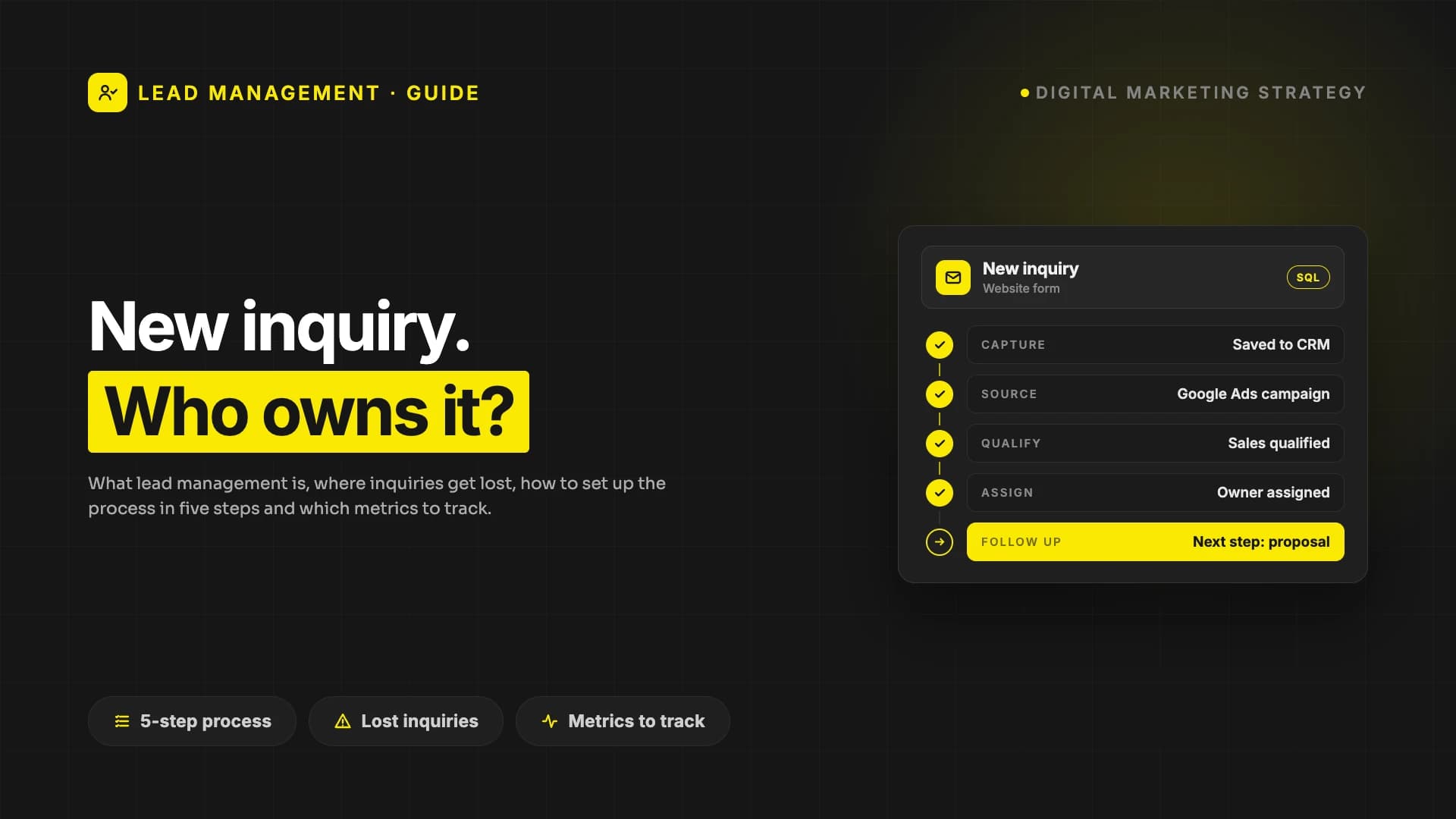
- Lead tracking: The source and outcome of incoming inquiries start being recorded. We explained how to set this up in our lead management post.
If all you have at the end of the month is a new campaign and a click chart, ask why measurement is still unclear.
Next step
Choosing a Google Ads agency is really a decision about whose hands your ad budget is in every month, and what it is measured against. If you want campaigns built on conversion tracking and fed by your sales data, check out our Performance Marketing & Growth and CRM & Revenue Infrastructure services and our work, or contact us to review your account together.
Frequently Asked Questions
What do Google Ads management services include?
Google Ads management services include setting up conversion tracking, campaign and keyword structure, ad copy, weekly optimization and reporting. A good service also measures whether incoming leads turn into sales, so decisions are based on real results instead of clicks.
Is it better to hire a Google advertising agency or manage it myself?
If you target one service in one area and someone on your team can review the account every week, you can manage it yourself. If you run several campaign types, countries or languages, or measurement includes CRM data, working with an agency is usually more efficient.
Is the Google Ads agency fee included in the ad budget?
Usually not. Ad spend is paid to Google and the management fee to the agency. Google's third-party transparency requirements say that an agency charging a separate management fee must inform new customers in writing before their first purchase and disclose the fee on invoices.
What happens to my Google Ads account if I stop working with the agency?
If the account was created under your company's name and you have Admin access, the account, its history and the campaigns stay with you; you can remove the link to the agency's manager account at any time. If the account was created under the agency's name, get the handover in writing before you sign.
Your site may look great. Does it actually work?
PumpAudit scans your site across 10 layers and 95 checks: speed, SEO, AI visibility, security, email and conversion. Your score is free and takes a minute or two.