
Google Ran a Spam Update and Said Nothing. The Numbers Say Plenty.
A two and a half day update, no announcement post, and the sharpest ranking swings of the year. We read the data so you do not have to.
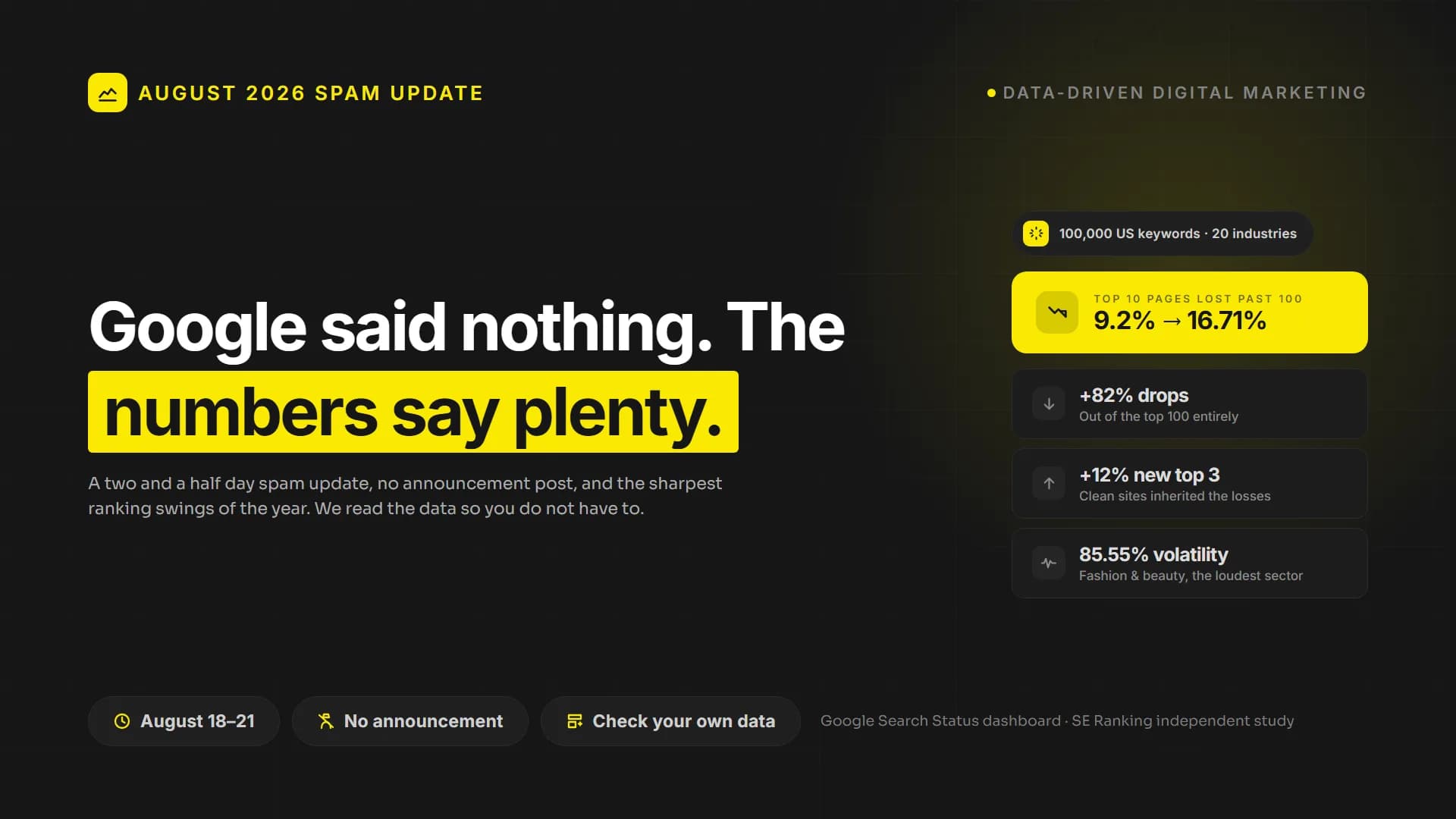
Google started the August 2026 spam update on 18 August and completed it 2 days and 16 hours later, on 21 August. The only official record is a two line entry on Google's own status dashboard. No announcement post, no new spam policy, no sentence explaining what was targeted.
The silence itself is the story, because the data says this was not a routine maintenance pass.
First, let us get the timeline straight
In late July and the first week of August, many site owners saw their rankings wobble and went hunting for a core update. Yet Google's status dashboard lists no update for that period; anyone reading tea leaves in early August was most likely reacting to noise. The only change on the official record is the spam update that began on 18 August.
That distinction matters. If your rankings moved in early August, this update was not the cause. If they moved after 18 August, the picture below is the one to study.
What the numbers say
SE Ranking tracked 100,000 US keywords across 20 industries and compared the update window (17 to 22 August) with a quiet baseline (26 to 31 July). The highlights:
- In the baseline period, 9.2 percent of pages ranking in the top 10 fell beyond position 100. During the update, that rate jumped to 16.71 percent. Put differently, a top 10 page was about 1.8 times more likely to vanish from the top 100 entirely.
- Drops from the top 10 out of the top 100 rose 82 percent compared with the baseline.
- There is a flip side: pages that had never cracked the top 20 entered the top 3 at a rate 12 percent higher than usual. As some sites fell, others rose.
- The turbulence covered all 20 industries. Even real estate, the calmest sector, showed 74.64 percent top 10 volatility; fashion and beauty reached 85.55 percent.
For a spam update, these are unusually sharp movements. For context, spam updates typically touch a narrow set of sites and pass unnoticed by most owners. Not this time.
What Google did not say
Google clarified exactly two things: that the update exists, and that it does not specifically target link spam or the site reputation abuse policy. Which spam type was targeted, which signals changed, why the impact was so broad: none of it was explained.
Independent data cannot fill that gap either; SE Ranking's analysis measures position movements, not which content types were penalised. So anyone telling you that you dropped because of one exact tactic is claiming knowledge nobody has.
What to do if your site dropped
- Confirm the diagnosis first. Find the exact day the decline started in Search Console. If it predates 18 August, this update is not your culprit; look elsewhere.
- Do not panic edit. Post update turbulence can run for weeks; hasty changes made while rankings settle make it impossible to see what actually works.
- Review the spam policies honestly. Google's published spam policies are the only reliable checklist: scaled low value content, hidden text, sneaky redirects, keyword stuffing. If any of it exists on your site, clean it up without waiting for the next update.
- Study your risers too. The 12 percent jump in fresh top 3 entries shows clean sites inherited their competitors' losses. Whatever pages of yours rose, produce more of that.
- Talk to your own data, not industry charts. Volatility indices describe the average; your site is not the average. Decisions come from your own Search Console and analytics.
Our read
Google shipping spam updates without announcement posts is a trend, and the message is clear: the policies are published, the rest is Google's business. For site owners it means chasing update timelines is worth less, and continuous compliance with the published rules is worth more. For sites that do not want to live at the mercy of the next update, the strategy has not changed: pages that give a real answer to a real question, clean technical foundations, and measurement.
Source: Google Search Status dashboard (August 2026 spam update entry). Impact figures compiled from SE Ranking's independent study of 100,000 US keywords.
Your site may look great. Does it actually work?
PumpAudit is the AI assisted auditor built by Pumpmedya. It analyzes your site across five areas, every finding is checked by a specialist, and the report is with you within 3 working days. Credited against your first project.
See PumpAuditKeep reading
 AI and Business Technology
Google Now Has an Off Switch for AI Answers, and a Price Tag. Our Data Says Which One Matters.
 AI and Business Technology
Google Now Shows Where AI Surfaces Your Site. Here Is What the Report Will Not Tell You
 Data-Driven Digital Marketing