

Google Just Updated Its Rules on AI-Generated Content. Here's What Changed.
On October 1, Google tied its AI content guide to two quality rater sections. Which sites are at risk and what to check this week.
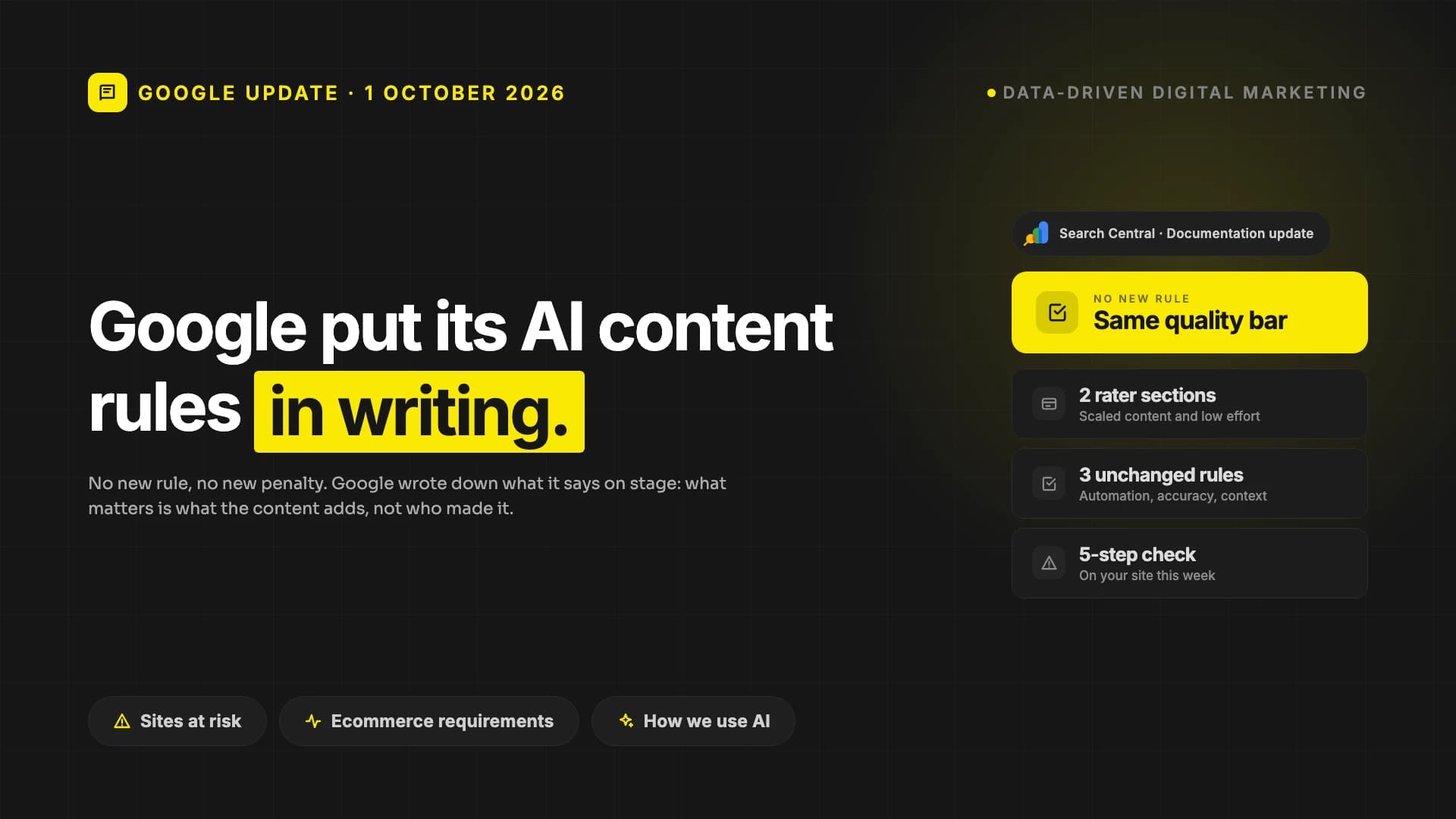
On October 1, 2026, Google updated its guide on using generative AI content, the page that sets its rules for AI-generated content. The update arrived quietly: no algorithm announcement, no new penalty. The reason given in the Search Central changelog is one sentence: to bring the documentation in line with the presentations Google uses at its developer events. In other words, Google did not write a new rule. It wrote down what it has been saying on stage for a while.
If your site produces, commissions or is considering AI-generated content, this post covers what changed, what did not, and what to do this week.
What changed in Google's AI content guidance
The previous version of the guide did not ban AI content either. What is new is that Google now describes "bad AI content" by pointing to its own Search Quality Rater Guidelines. The guide sends readers to two sections:
- Scaled content abuse (section 4.6.5). Producing many pages without adding value for users. The guide says plainly that this can violate the spam policies.
- Main content with little to no effort, little to no originality and little to no added value (section 4.6.6). The test here is not who made the content but what it adds.
Google adds a caveat in the same place: the rater guidelines are not a guide to ranking first in Google, and rater scores do not directly influence ranking. The guidelines describe the quality Google's systems aim for. Tying the AI guide to them means one thing: Google does not treat AI content as a separate category. It applies the same bar it applies to everything else.
Three rules that did not change
The update left the backbone of the guide intact. Three rules still stand:
- Automation itself is not the problem. The guide says generative AI can help with research and with structuring original content. The issue is not the tool, it is output that adds nothing.
- Accuracy is your responsibility. Google reminds you that generative models predict likely word sequences rather than retrieve facts. Google calls human review before publishing critical, and it covers everything that can appear in Search results: page titles, meta descriptions, structured data and image alt text.
- Give readers context. The guide recommends explaining how automation was used, in a way that suits your audience. For images, the way to do that is metadata.
Extra requirements for ecommerce sites
The most concrete part of the guide is for online stores. On the Google Merchant Center side there are two requirements:
- AI-generated images must carry the IPTC
DigitalSourceTypevalueTrainedAlgorithmicMedia. - AI-generated product titles and descriptions must be supplied in separate fields and labeled as AI-generated.
For stores filling their catalog with AI, these are Merchant Center requirements, not suggestions.
Which sites are at risk?
Three questions apply the guide's definition to your own site:
- Do your pages look alike? Hundreds of pages built from one template, with the same sentence structure and only the city or product name swapped, are the textbook case of scaled content abuse.
- Does the page repeat what is already online? Content that summarizes a topic without adding any new information, experience or data falls under the "little added value" definition.
- Did a person read it before it went live? A wrong number, an invented source or a feature that does not exist damages reader trust and fails Google's accuracy expectation.
If you can comfortably answer "no, no, yes", the update is good news for you: some of your competitors cannot say the same.
How we use AI ourselves
This guide applies to us too. We are an AI-powered agency and we use AI in content production. Our method matches the guide's three rules:
- Topics come from our own search data. We read which queries earn impressions and which pages compete with each other; we described that process in our data-driven SEO guide.
- Drafts are structured with AI, but every number and every claim is checked by a person before publishing. An unapproved number does not go live.
- External links go only to primary sources, which in this post means Google's own pages.
The process is not slow; it is more than enough for one post a week. What slows teams down is not the review step, it is cleaning up content that was published without one.
What to do this week
- List your AI-generated pages. Which pages were produced with automation, and how many were read before publishing?
- Merge or remove near-duplicate pages. Consolidating pages that serve the same intent into one strong page helps with this guide and with rankings.
- Check your meta fields. Titles, descriptions and structured data are inside the guide's scope; if they were automated, they need one read.
- If you sell online, update your image and product feeds. IPTC metadata and labeled AI product fields.
- Add one sentence of disclosure. A single line telling readers how you use AI is a simple way to follow the "give users context" recommendation.
Frequently asked questions
Does Google penalize AI-generated content?
No. The guide says the question is what the content adds for users, not how it was produced. What can violate the spam policies is producing many pages without adding value for users.
Do I have to disclose that I used AI?
The guide presents disclosure as a recommendation, not a requirement. Ecommerce images and product data are the exception: labeling is required there.
Is this an algorithm update?
No. The changelog lists it as a documentation update. What changed is that the guide now points to these criteria in writing.
How should I check an AI-assisted page before publishing?
Look at three things: does every number and claim have a source, does the page give readers more than what is already online, and do the title and meta description say what the page actually covers? These three checks are a good start; ecommerce sites also need to label AI-generated images and product data.
Do the Quality Rater Guidelines decide rankings?
In Google's own words, no: rater scores do not directly influence ranking. The guidelines show the quality definition Google aims for.
Next step
Producing content with AI speeds you up when it is done right and puts the whole site at risk when it is not. If you would like to see where your content stands against this guide, take a look at our SEO and GEO services or get in touch.
Your site may look great. Does it actually work?
PumpAudit is the AI assisted auditor built by Pumpmedya. It analyzes your site across five areas, every finding is checked by a specialist, and the report is with you within 3 working days. Credited against your first project.
See PumpAuditKeep reading
 AI and Business Technology
Google Now Has an Off Switch for AI Answers, and a Price Tag. Our Data Says Which One Matters.
 AI and Business Technology
Google Ran a Spam Update and Said Nothing. The Numbers Say Plenty.
 AI and Business Technology