

Answer Engine Optimization: What the Numbers Actually Say
AI assistants send under 1% of web traffic yet reshape who gets found. The real AEO numbers: zero-click rates, branded search effects, and what is worth doing.
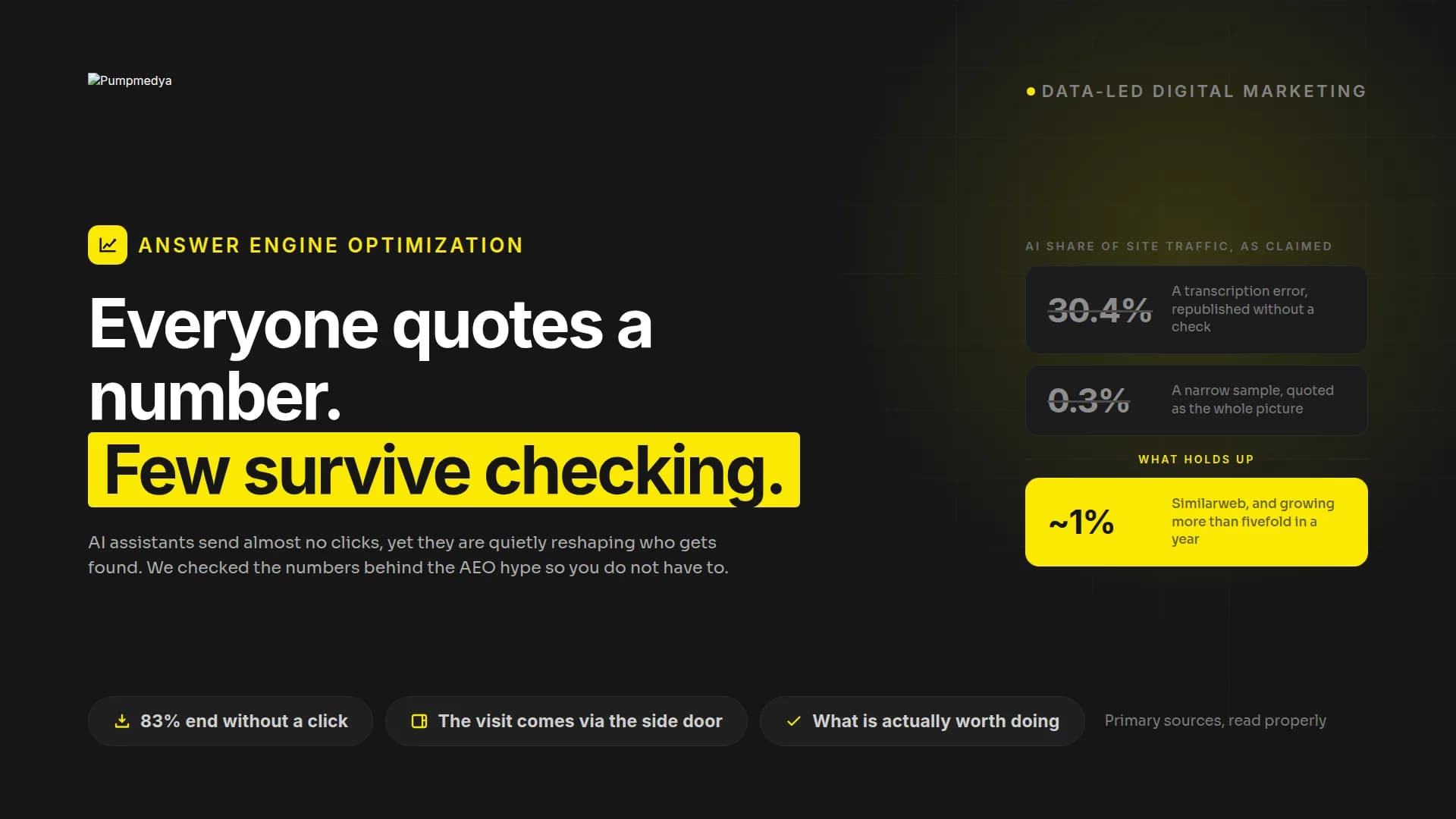
Everyone selling you "AI visibility" has a statistic. The statistics do not agree.
While researching this piece we found the share of website traffic coming from AI assistants quoted as 0.3 percent, "roughly 1 percent" and, in one widely shared roundup, 30.4 percent. The last one is an aggregation error that nobody bothered to check before republishing. That, in one sentence, is the state of the AEO conversation in 2026: a real shift, wrapped in numbers that fall apart the moment you read the primary source.
So let us read the primary sources.
What AEO actually is
Answer engine optimization (you will also see GEO and AIO; the naming contest is still running) is the practice of making your content visible inside AI generated answers: ChatGPT, Gemini, Perplexity, and Google's AI Overviews. Classic SEO competes for a ranking. AEO competes for a citation: being the source the answer is built from, whether or not anyone clicks through.
The honest numbers
AI assistants send very little traffic. Similarweb's measurements put AI referrals at roughly 1 percent of total website visits, with ChatGPT responsible for around nine tenths of that. If someone promises that AI answers will replace your search traffic this quarter, they are selling something.
But the curve is steep. Semrush's traffic study measured AI search referrals growing more than fivefold in a single year. A channel at 1 percent growing at that rate is exactly the kind of thing that looks irrelevant right up until it is not.
The real effect does not show up as a click at all. SparkToro and Datos found that when an AI Overview appears on a Google result, about 83 percent of those searches end without a click to any website, against roughly 60 percent for ordinary results. The answer got consumed; nobody visited anyone. Your content can win the argument and never see the visitor.
The visitor arrives through the side door. Similarweb's analysis suggests that more than half of AI influenced visits reach brands through branded search rather than a referral link: someone asks an assistant, sees a name recommended, then googles the name. Seeing a brand recommended in an AI answer makes a user roughly 2.5 times more likely to visit that brand's site. If you only measure referral clicks, you will conclude AI does nothing, and you will be wrong for a measurable reason.
The traffic that does arrive behaves differently. One agency study (Exposure Ninja) reports AI referred visitors converting at 14.2 percent against 2.8 percent for organic search. Treat the exact figures with caution; different studies report different magnitudes. The direction, however, is consistent across sources: a visitor who arrives after an assistant recommended you has already been sold.
What the sceptics got right
The 2023 sceptics called AEO "SEO in a new hat", and on the mechanics they were largely correct. Teams that bet on abandoning SEO fundamentals for AEO tactics regretted it: crawlability, technical health, authoritative content and structured data are precisely what answer engines feed on. There is no secret optimization that bypasses doing the work. Anyone guaranteeing you a placement inside ChatGPT's answers is guaranteeing something no one controls.
What is actually worth doing
- Write answer shaped content. Clear questions as headings, direct answers in the first sentences under them. Structured content gets cited measurably more often than prose walls.
- Keep your structured data honest. FAQ and article schema, consistent organisation details, a real about page. Assistants resolve entities before they cite them; be an unambiguous entity.
- Update what you already rank for. Freshness is one of the few levers with measured citation impact, and it costs less than new content.
- Measure the side door, not just the front. Track AI referrals in your analytics, but watch branded search volume alongside it. That is where the influence surfaces.
- Ask the assistants about yourself. The cheapest audit in marketing: ask the major assistants what they say about your brand and your category, and read what they cite. Do it quarterly; the answers move.
Where we stand
We build measurement infrastructure for a living, so our bias is predictable: we do not believe channel claims we cannot see in data, and we extend the same scepticism to our own. We run AI visibility checks for our clients as a checklist, not a magic score, and we tell them what we found rather than what they hoped. If you want to know what the answer engines currently say about your business, ask us for a free audit and we will look.
Your site may look great. Does it actually work?
PumpAudit is the AI assisted auditor built by Pumpmedya. It analyses your site across five areas, every finding is checked by a specialist, and the report is with you within 3 working days. Credited against your first project.
See PumpAuditKeep reading
 Data-led Digital Marketing
Data-Driven SEO Strategy: Why Impressions Rise but Clicks Don't
 AI and Business Technology
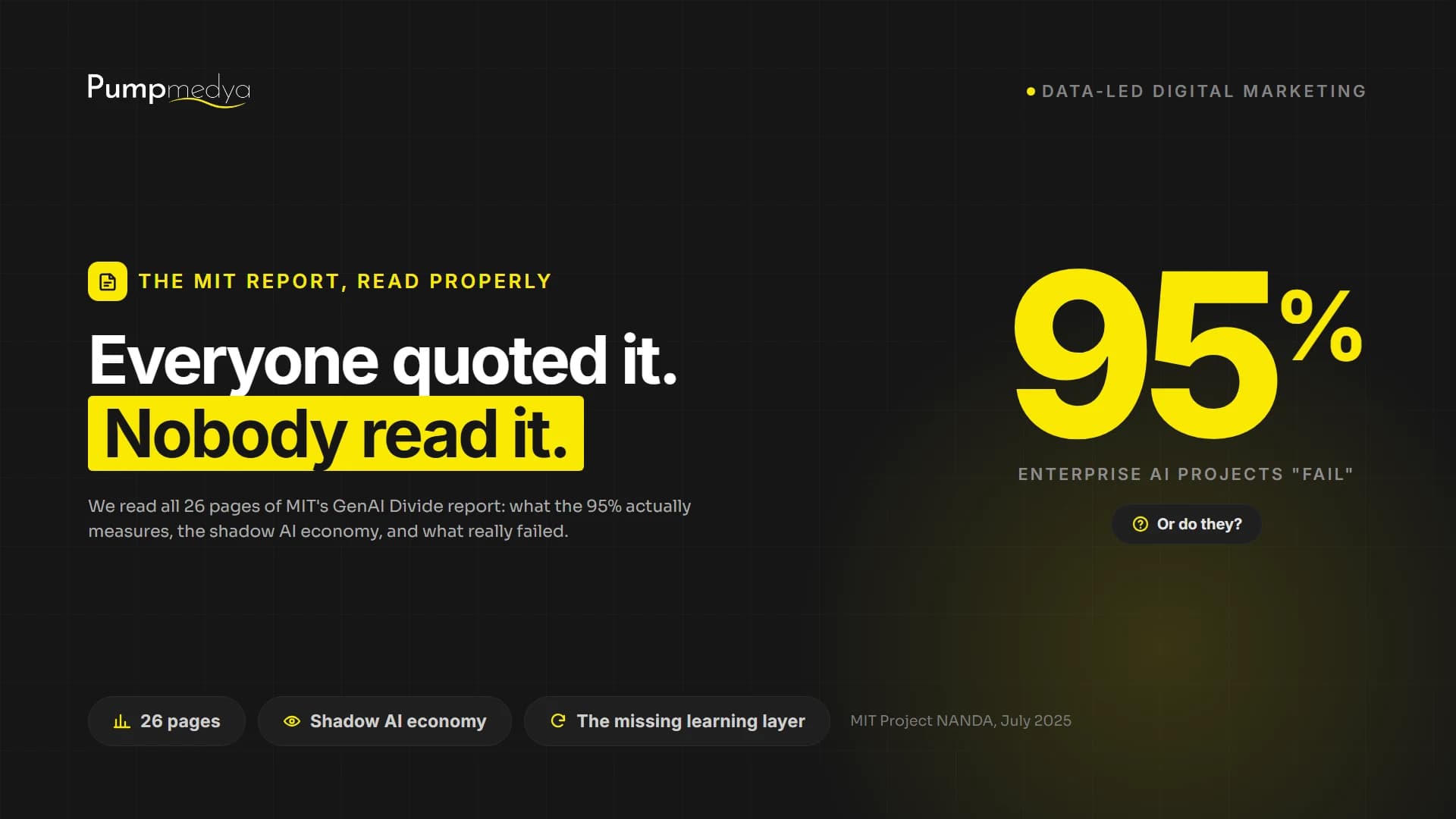
Do 95% of Enterprise AI Projects Really Fail? A Closer Read of the MIT Report
 Data-led Digital Marketing