
What Does a Google Ads Agency Do? Scope, Fees and Questions to Ask
A Google Ads agency is the team that sets up, manages and measures your advertising account. We explain what a good Google Ads service covers, how fees are set, why the account should stay in your name and which questions to ask before you sign.
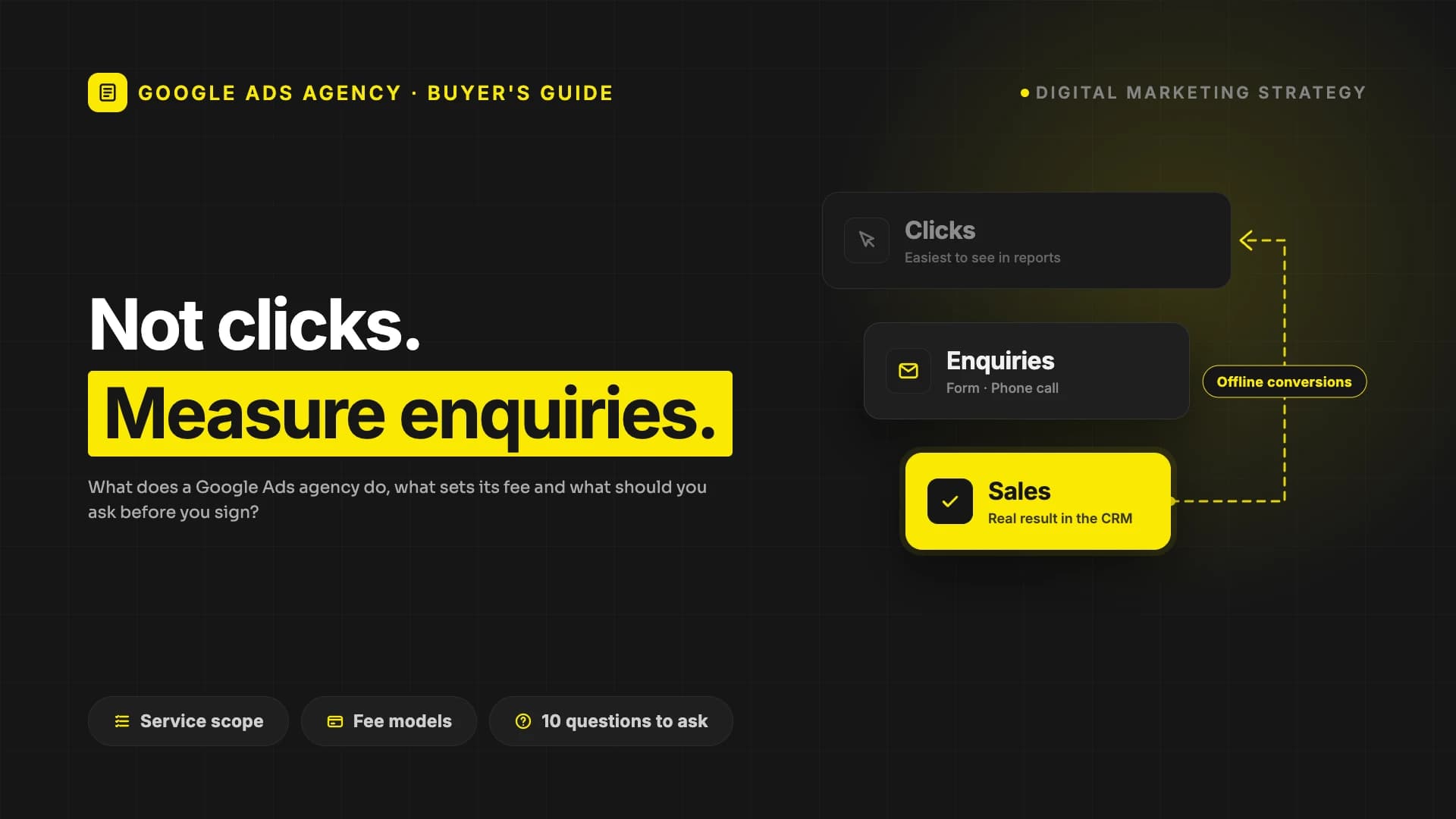
Short answer: A Google Ads agency is the team that sets up, manages and measures a Google advertising account on a business's behalf: conversion tracking, campaign structure, ad copy, bidding strategy and reporting. To choose the right agency, look past promises of clicks and ask how it measures qualified enquiries and sales, how it explains its fee and who keeps the account.
Once you decide to bring in a Google Ads management service, the first thing you notice is how alike all the proposals look. Most promise more clicks, lower costs and quick results. The difference usually shows a few months later, once a large share of the budget has been spent: clicks in the reports have gone up, but the enquiries coming in are not what you expected.
In this article we explain what a good Google Ads agency actually does, how fees are set, what the Google Partner badge means, why the account should stay with you and which questions to ask before you sign a contract. If you would like to learn how Google Ads works from the ground up first, start with our Google Ads guide.
What does a Google Ads agency do?
Google Ads management is not about setting up a campaign and walking away. It means reviewing and improving the account every week. A good Google Ads service usually covers the following:
- Measurement setup: Recording real goals such as form submissions, phone calls or purchases correctly as conversions. Without this, budget and bidding decisions rest on guesswork.
- Account and campaign structure: Choosing campaign types to suit your services, regions and budget, and grouping keywords in a way that makes sense.
- Ad copy and assets: Headlines that match the search, copy that says clearly what your business offers, sitelinks and other ad assets.
- Landing page recommendations: Pages that repeat the promise of the ad and make the next step obvious. If the page is weak, even the best campaign wastes budget.
- Weekly optimisation: Reviewing the search terms report, adding unwanted searches as negative keywords, and adjusting budgets and bids based on results.
- Reporting: A regular report that explains what was done, what changed and what that means for enquiries or sales.
- Connection to sales data: Sending information from your CRM about which enquiries became customers back to the ad account as offline conversions. That way Google's automated bidding learns from real sales, not from the number of forms.
If a proposal only mentions campaign setup and a monthly report, the part of the work that makes the most difference is missing: regular optimisation and measurement.
How are Google Ads agency fees set?
First, separate two items: the ad spend paid to Google and the management fee paid to the agency. Depending on the campaign type, ad spend is mostly paid to Google per click or per conversion. The management fee is what the team running the account charges. Agencies usually set this fee in one of four ways:
- Percentage of spend: The fee is a set percentage of monthly ad spend. It is simple, but the fee rises as spend rises, so weigh any advice to increase the budget with that in mind.
- Fixed monthly fee: A fixed fee for work whose scope is agreed in advance. Budgeting becomes easier; having the scope in writing matters.
- Hybrid model: A fixed base fee, plus a percentage on the part of spend above an agreed amount.
- Performance-based fee: Payment per enquiry or per sale. It sounds attractive, but unless the definition of an "enquiry" is pinned down in writing, volume may end up being chased instead of quality.
The main factors that set the fee are the type and number of campaigns, how many countries and languages are targeted, who prepares the ad copy and visuals, whether landing page work is in scope and whether measurement covers CRM data or offline sales.
Google also has a rule for agencies here. Under Google's third-party transparency requirements, an agency that charges a management fee separate from the cost of Google Ads must inform new customers in writing before their first purchase and disclose the fee on customer invoices. If a proposal rolls ad spend and the management fee into a single figure, your first question should be how much each of them is.
What does the Google Partner badge mean?
The Google Partner badge shows that an agency meets requirements set by Google. According to Google's Partners programme page, these fall into three categories: a minimum optimisation score of 70% on the manager account registered with Google Partners, at least $10,000 USD of ad spend across managed accounts over 90 days, and at least half of the account strategists certified in Google Ads. Premier Partner status goes to companies that meet these requirements and are in the top 3% of participating companies in their country, and it is determined annually.
The badge shows that the agency manages a certain volume of ad spend and that its team is certified. It does not guarantee results in your sector with your budget. Optimisation score, one of the badge requirements, also needs to be read correctly: Google defines it as an estimate of how well your Google Ads account is set to perform, and notes that you can dismiss recommendations that are not relevant to your campaign. Applying every recommendation just to raise the score may not be right for your account. A good agency weighs recommendations one by one against your goals and turns down the ones that do not fit, with a reason.
Who should own the account?
This is one of the first things to settle before you sign. The Google Ads account, the conversion tracking setup and the Google Analytics property should be opened in your company's name, and you should keep Admin access for at least one of your own users.
Google Ads has five access levels: Admin, Standard, Read only, Billing and Email only. Only Admin access lets you decide who can access the account and unlink the agency's manager account. Agencies usually manage client accounts by linking them to their own manager account; according to Google's manager account page, users with administrative access to the client account can end this link at any time.
If the account was opened in the agency's name, you may not be able to take years of campaign history and conversion data with you when you stop working together. Whoever's name the account is in, Google requires agencies to give customers their Google Ads customer ID when requested. Ask for this ID in the first meeting.
Red flags when choosing a Google Ads agency
- Guaranteed rankings or clicks: An auction decides on every search whether an ad is shown, so nobody can guarantee a specific position or number of clicks. In its third-party policies, Google also lists guaranteeing top placement, offering "unlimited clicks" and making false statements about how costs are calculated among its examples of misleading claims.
- No access to the account: If you cannot see your account, every figure in the reports is one the agency chose to show you.
- Click reports instead of conversions: Clicks, impressions and click-through rate are interim indicators. If the report says nothing about enquiries, sales and cost per enquiry, the question of whether the ads work goes unanswered.
- Automated bidding without measurement: Smart Bidding strategies learn from conversions. A system working with wrong or incomplete signals optimises for clicks that never turn into customers. We explained in our post on the bidding change why, since August 2026, the figure entered in the Target CPA field works as a target rather than a ceiling.
- Pressure and persistence: Google's policy prohibits putting undue pressure on advertisers to sign up or stay with an agency, and repeatedly cold calling potential advertisers.
10 questions to ask a Google Ads agency before you sign
- In whose name will the account, conversion tracking and Google Analytics be set up? Will Admin access stay with us?
- What exactly will you do in the first month, and who will look after our account?
- What will we count as a conversion, and how will you test that it is recorded correctly?
- How will we measure whether an enquiry turns into a sale? Can you send CRM data back to the ad account?
- How is your management fee calculated, and will it appear on the invoice separately from the ad spend?
- How often do you review the account, and when do you read the search terms report?
- What will the report include, and who will talk us through it?
- Who will prepare the ad copy, the visuals and the landing page changes?
- Can you show us work in a similar sector or with a similar budget that you have permission to share?
- If we stop working together, who keeps the account, the data and the ad assets? What is the notice period?
How clear the answers are matters as much as the answers themselves. An agency that says "we cannot give you a firm figure without seeing your account; this is what we need to look at" is usually more trustworthy than one that promises costs and results in the first meeting.
What does a good first month look like?
Expecting big results in the first month is not realistic, but you should see this work:
- Baseline: Current spend, the number of enquiries and the cost per enquiry are recorded.
- Measurement check: Conversions are tested; tags that count too many or too few are fixed.
- First fixes: Searches and settings that waste budget are found; negative keywords, location and ad schedule settings are applied, not just listed.
- Enquiry tracking: The source and outcome of incoming enquiries start being recorded. We explained how to set this up in our lead management post.
If all you have at the end of the month is a new campaign and a click chart, ask why measurement is still unclear.
Next step
Choosing a Google Ads agency is really a decision about whose hands your ad budget is in each month, and which yardstick it is spent against. If you want campaigns built on conversion tracking and fed by your sales data, take a look at our Performance Marketing & Growth and CRM & Revenue Infrastructure services and our work, or get in touch to review your account together.
Frequently Asked Questions
What does a Google Ads service include?
A Google Ads service covers setting up conversion tracking, campaign and keyword structure, ad copy, weekly optimisation and reporting. A good service also measures whether incoming enquiries turn into sales, so decisions are based on real results rather than clicks.
Is it better to work with a Google advertising agency or manage it myself?
If you target one service in one region and someone on your team can review the account every week, you can manage it yourself. If you run several campaign types, countries or languages, or measurement covers CRM data, working with an agency is usually more efficient.
Are Google Ads agency fees included in the ad budget?
Usually not. Ad spend is paid to Google and the management fee to the agency. Google's third-party transparency requirements say that an agency charging a separate management fee must inform new customers in writing before their first purchase and disclose the fee on invoices.
What happens to my Google Ads account if I stop working with the agency?
If the account was opened in your company's name and you hold Admin access, the account, its history and the campaigns stay with you; you can remove the link to the agency's manager account at any time. If the account was opened in the agency's name, agree the handover in writing before you sign.
Your site may look great. Does it actually work?
PumpAudit scans your site across 10 layers and 95 checks: speed, SEO, AI visibility, security, email and conversion. Your score is free and takes a minute or two.